Program: “Law for All: A Transversal Approach to Law through Literature”
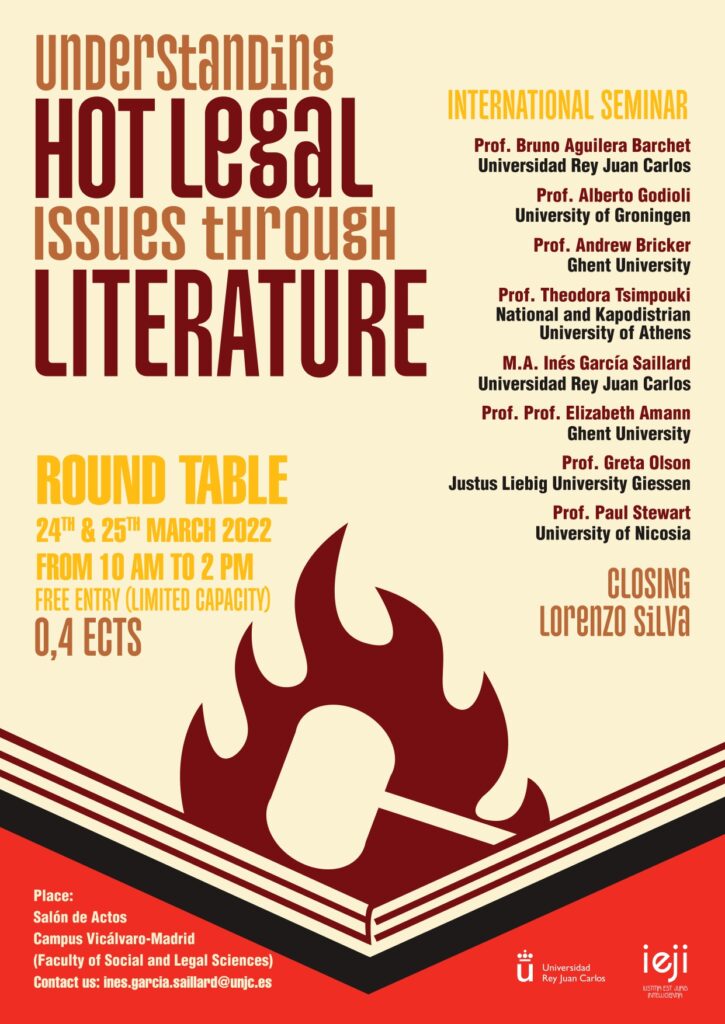
It is clear that studying at a law school is essential for those who want to become professional jurists. However, it is reasonable to ask “What about everyone else?” Everyday people. Don’t they have a «right» to understand the law? Should law continue to be a province restricted to a small circle of insiders? Or, on the contrary, is it possible, and event desirable, to reveal the most distinctive and essential features of the law to a broader audience?
This appeal is more relevant than ever, as the law is an everyday part of our lives. From the cradle to the grave (and even before being as foetuses, under the principle of nasciturus), and even after we die (our wills having legal effects) we are surrounded by the law. Thus, I believe it very worthwhile for us to understand what the law says, and what it means, if only so that our politicians, and the powerful (who have enough money to hire legions of lawyers) do not trample upon or deceive us.
In light of the foregoing, should the law remain exclusively confined to university classrooms? It is clear that it should not. This is why is so important to offer an amenable approach to the legal realm, one shunning the elitism typical of legal treatises, spurring one of the 20th century’s most important legal philosophers, Britain’s H.L. Hart (1907-1992) to advocate for the «demystification of law».
We propose to nurture an understanding of the law, not so much by drawing upon essentially scholarly, academic works, but rather through more accessible and effective sources, including not only literary texts and references, but also elements of all kinds of «works of art», in the broadest sense of the term, that I believe can convey the essence of a legal question more directly to my readers.
The idea is to develop a method of transversal approach to Law from a large cultural background that will ease Legal understanding for everyone not having a Legal Education.
Reading Club IEJI
 The Institute of International Legal Studies, in its constant quest for including multidisciplinarity, has established since 2017 a Reading Club, called «Club de Lectura IEJI» where classic and contemporary books are read and commented twice a month.
Coordinated by Inés García Saillard, IEJI’s Activities and Project Coordinator and Research Assistant, it is structured by themes that go from issues on literary creation to a season focused on American Literature. The main objective of the Reading Group is to grasp a good knowledge of selected books and to teach how to approach literary works in enjoyment and self-opinion.
Film Club IEJI
Created as an extension of the Reading Club, the Film Club has nonetheless acquired its own personality and is now a well-established IEJI’s activity. Coordinating by Inés García Saillard, it combines film screening with a later debate. Usually in combination with Reading Club’s program, it aims to integrate multidisciplinary favoring debate and reflection on contemporary issues.
Debate is particularly enticing and it provides participants with a solid culture on history of cinema and teaches them to view cinema as part of cultural studies. Film Club IEJI is structured by themes and aims to approach cinema in an enjoyable, participative and argumentative way.